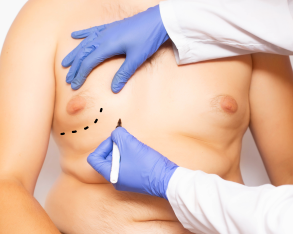
Sculpting of the male chest

Gynecomastia surgery – surgical correction of the male breasts

The age of puberty is a time when both boys and girls not only change physically as they mature but also begin to care for their looks a lot. My case was the same. Like many of my friends, I got interested in exercising and willing to go to the gym. I beg

Gynecomastia surgery is a technique of reducing male breasts designed to remove a hypertrophied mammary gland, redundant fatty tissue, and possible skin excess from this region and to form a male, elegant chest profile. 

Details of your procedure

The surgeon begins with a standard periareoral incision along the line between an areola and the surrounding skin. S/he proceeds to separate the skin from the mammary gland, gaining access to the tissue to be reduced. A suction drain can be inserted on removal of excess fatty tissue and hypertrophied mammary gland. The wound is sewn with very fine surgical suture. In case of a larger gynecomastia, excess skin may need to be removed. 

Gynecomastia, or presence of a clinically manifested mammary gland in men, occurs as hormones rage in infants, pubescent boys, and elderly gentlemen. It happens for a short time after birth in babies. It is estimated to arise in more than a half of pubescent boys and passes untreated in most of them as they become mature. Men after 50 suffer from the condition as well.

There are many causes of the male mammary gland hypertrophy. Excessive accumulations of fatty tissue or fluctuations of sex hormones including oestrogens and androgens are common causes of gynecomastia. In some people, however, it can be caused by a number of medical conditions and therefore require more in-depth diagnostics. Gynecomastia occasionally has a genetic background, too. It may also be a result of using certain drugs and hormones, alcohol abuse or consumption of steroids by men desiring to build their muscle mass too fast.

Prior to a breast reduction surgery, the cause of gynecomastia is diagnosed. Gentlemen with a mammary gland hypertrophy may be referred to imaging testing to rule out chest neoplasms and for a series of laboratory tests. Possible pathologies of the male attributes, that is, testicles and prostate, as well as lung, liver, kidney, and thyroid conditions which may cause gynecomastia, need to be eliminated.

Male breast hypertrophy may involve small, medium, and significant changes. Extent of a surgery will depend on their specific nature. Following a gynecomastia correction, an extremely popular procedure, especially with young men, Patients have a well-shaped, male chest. This spectacular shape may also contribute to improved self-assessment and self-confidence.

Preparation for your procedure:

Patients planning or expecting a surgery are requested to read ‘Guide for the Patient – preparation for your procedure’, available in the INFORMATION section.

Recommendations following a male breast reduction:

  • Stay at the clinic: the Patient remains at the clinic for 1 day if general anaesthesia is administered;
  • Dressing and special clothing: your dressing should be changed every day, preferably after a bath; the Patient should wear a special pressure vest for 8 weeks after the surgery that will shape the body region operated on;
  • Reduced mobility: limit intense physical activity 2 weeks after the surgery, including exercises involving chest muscles; you can take up sports and exercise again after 2 months, though only on consultation with your doctor and if they don’t cause pain in the chest region;
  • Medication: the Patient can only take medication consulted with his doctor, including any antibiotics; administer strong painkillers with caution; you mustn’t take aspirin or other drugs interfering with blood clotting; a special scar ointment is recommended;
  • Other: you mustn’t go to a sauna for at least 6 weeks; you can’t sunbathe the areas operated on for 6 months; a high UV filter cream is recommended;
  • Follow-up visits: Patients must attend follow-up visits arranged with their doctor.

Patients will be informed in detail about any recommendations following their procedures at the clinic.

More

Frequently asked questions:

A surgery is currently the only technique of male breast reduction. In spite of developments in medicine, no alternative procedures are available to help solve this male issue.

Scars are left by any surgical procedures. Their extent depends on breast size before the operation, the surgical technique applied, and on whether excess skin is removed together with fatty tissue. Generally speaking, the smaller the scope of correction, the smaller the skin incisions that leave little scars. A more extensive surgery leaves more traces. Remember properly cared scars become less manifest and troublesome. Most scars pale to such a degree it’s hard to discern them from the surrounding skin within 6-12 months as a rule.

Surgeries of this type are normally conducted after the age of puberty. Gynecomastia recedes spontaneously in most young men at this age. It’s a good idea to wait and see if a surgical intervention is needed at all. If the breast hypertrophy is manifested after puberty, diagnostic testing is recommended to indicate other than hormonal causes of gynecomastia.

There is no such limit in general. The Patient’s overall health condition determines if the surgery can be undertaken. Keep in mind, though, the risk of conditions that become contraindications to a number of procedures including the correction of male breast size, increases with age.

Effects of the surgery are lasting, since fatty and gland tissues have been removed. However, an unhealthy lifestyle, continued hormone fluctuations, drugs or weight growth my contribute to another gland hypertrophy, fatty tissue accumulation in the chest region, and changes of its appearance.

Every surgery entails the risk of complications. The Patient will be informed about general complications and those specific to this procedure at a qualifying medical appointment.

A natural end result is the goal of any aesthetic surgery. The same applies to gynecomastia correction. It gives the Patient a symmetrical chest with a natural appearance.

Liposuction only can be administered in case of a moderate breast expansion caused by fatty tissue accumulation in this area.

Diet, exercise, and loss of body weight won’t solve the problem. They may reduce the volume of fatty tissue in your breasts but will not reduce a hypertrophied mammary gland. A surgical technique of breast reduction is the best solution.

Return to your job depends on the kind of work you do. If the Patient works in an office and his duties don’t require much physical activity, he can go back to work 5–7 days after the procedure. If he does manual labour, on the other hand, he should wait at least 10 to 14 days and consult his doctor before.

Information about the procedure:

Duration 

About 1.5 h

Anaesthesia 

General

Stay at the clinic

1 day

Suture removal 

7-10 days after the surgery

Effect of the surgery

Long-term, fully manifest after 6-8 months

Contraindications 

Hypertension or diabetes issues, skin conditions in the chest area

Expert

Get to know
our Expert better

Check