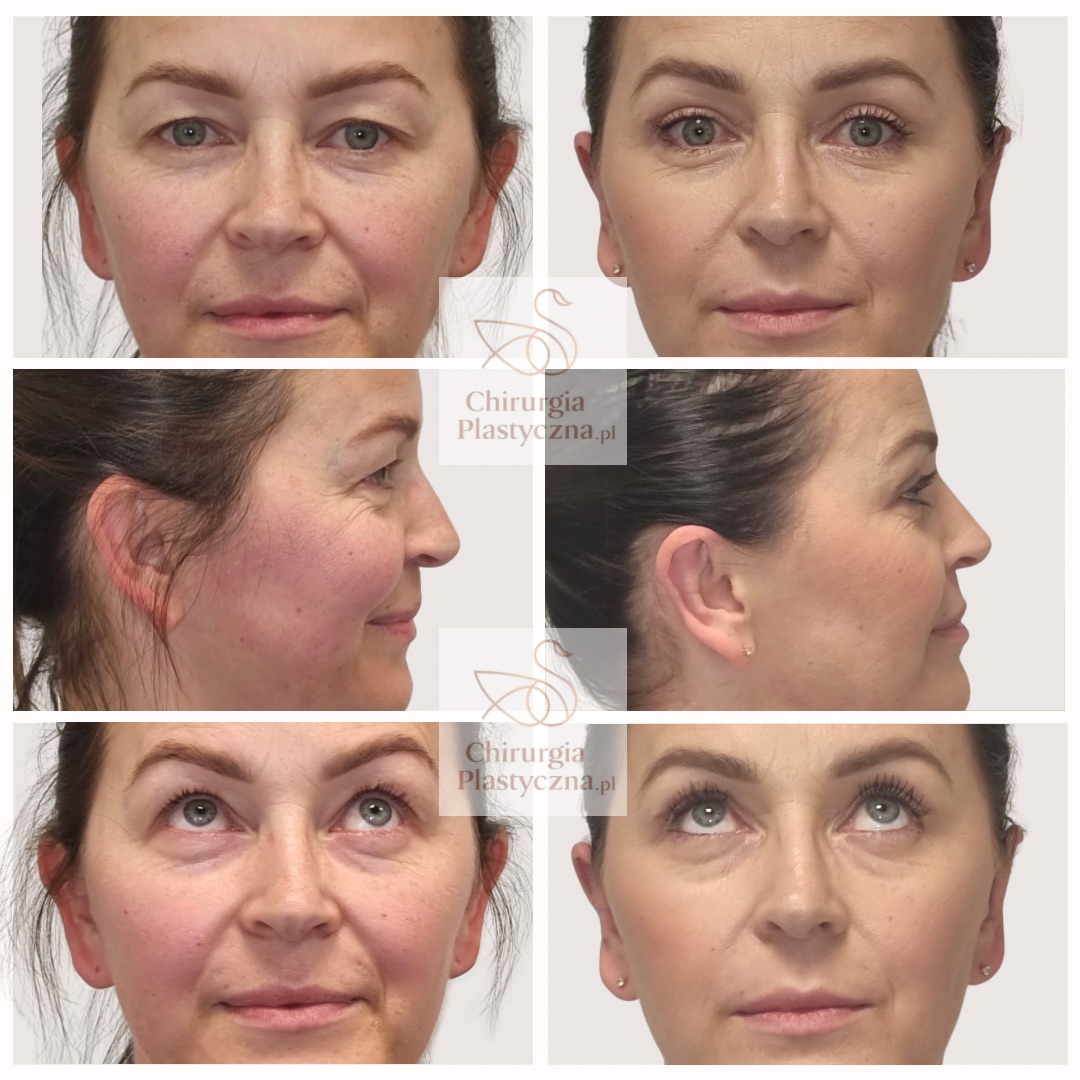
The plastic surgeon incises the skin behind the auricle. Given this access to the posterior surface of the ear cartilage, work can begin on a desired shape of this region. The cartilage can be incised or modelled as appropriate. Following an appropriate forming of the auricle, some techniques provide for a highly natural appearance of your ear after the surgery. The Patient can appreciate effects of the plastic surgeon’s work already at the time of the procedure.
Postoperative incisions are sewn with very fine surgical suture. As a rule, absorbable sutures are used that vanish in the process of healing and don’t have to be removed. They remain in your body for longer and thus better stabilise the ear structures operated on. Non-absorbable sutures can be placed as an alternative, removed after a week. Modelling dressing is applied following a surgery, to be replaced with your own band afterwards.
Protruding auricles can be observed in as many as 5% of the population. This aesthetic defect affects both women and men and is frequent within families. One ear can protrude or both do to different degrees. Irregular protrusion of auricles arises in a foetus, normally between the 8th and 11th week of pregnancy.
There’s no ideal, model ear. Each is individual and unique. What’s more, not every protruding auricle seems abnormal. A small ear may look not bad even if the angle between the auricle and skull bones is relatively large. And vice versa, a large ear that is correctly positioned relative to your head may be seen as protruding. All is a question of taste and sensitivity.
Too large and protruding ears are most often operated on. Auricles subject to surgeries before, whose appearance still fails to satisfy their owners, are corrected, too.
Otoplasty is a procedure after which the Patient has ears of a more natural shape and proportional to the rest of the face. Correcting even little deformations may have a positive impact on the overall face appearance and level of your self-assessment.
First effects can be noted as early as during the surgery. Your ear will gain its ultimate appearance after a few months. Otoplasty gives the Patient a pleasing, shapely ear at an appropriate inclination to the head, which becomes an attractive part of your face.
Preparation for your procedure:
Patients planning or expecting a surgery are requested to read ‘Guide for the Patient – preparation for your procedure’, available in the INFORMATION section.
Recommendations after an otoplasty:
- Stay at the clinic: following local anaesthesia, the Patient will be able to return home on the very same day;
- Reduced mobility: you mustn’t do physical exercise for 4 to 6 weeks, whereas walking is recommended;
- Dressing and special clothing: the Patient wears a surgical band for the first week after the surgery, to be replaced with a band of their own for the next 3 weeks, which should be worn day and night. For another 3 weeks, the Patient will wear one during the night only. A band shouldn’t be too tight on your head;
- Medication: antibiotics are not usually administered after the procedure; the Patient takes drugs agreed with their doctor, if needed. Aspirin or other drugs interfering with blood clotting shouldn’t be taken, either;
- Other: sleeping on a soft bed and loose clothes are recommended. Long phone conversations and wearing of earplugs are prohibited for even 14 days after the surgery. A light diet without products requiring intense biting and long chewing. You mustn’t smoke or be in the presence of smokers, drink alcohol or drinks containing caffeine until the healing process is complete. Glasses can only be worn 4 weeks after the surgery; avoid sunbathing and solarium for 6 months.
- Follow-up visits: Patients must attend follow-up visits arranged with their physician.
Patients will be informed in detail about any recommendations following their procedures at the clinic.