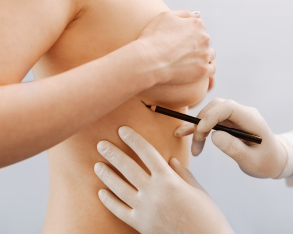
Recover comfort of your life from before breast cancer treatment!

Breast sharing – breast reconstruction and a simultaneous symmetrisation of the contralateral breast

I’ve lost one breast in effect of cancer treatment. I’m masking its absence with a prosthesis. I can’t quite get used to this ersatz symbol of femininity, though. That’s why I’ve been thinking of a surgical reconstruction of my missing breast. My other br

Breast sharing is a simultaneous autologous reconstruction and symmetrisation designed to recreate the body area that has been lost to mastectomy using the other breast tissue and modelling of the healthy breast. 

Details of your procedure

The surgery involves collection of a vascularised tissue of an adequate size from the existing breast and transfer to the location of the removed organ. A new mammary gland is formed out of the tissue and of the skin and fat bits remaining after the mastectomy. The donor and reconstructed breast are then properly formed into a shapely, symmetrical cleavage. 

Post-cancer patients, especially those whose treatment required removal of a affected breast, suffer not only from their ailment but also from the loss of an attribute of their femininity. They can be helped out of this quandary with temporary external breast prostheses and, in particular, a wide range of surgical options.

Women after a mastectomy can resort to a number of techniques to reconstruct their breasts. Placement of implants or transfer of tissue flaps from various remote regions of patients’ bodies have been the most popular for years. Although the methods using your own tissue guarantee a beautiful cleavage, they are associated with the risk of complications in places of transplant material harvesting and produce additional scars.

To minimise any risks and reduce the Patient’s discomfort after she suffered enormous pain due to her cancer, techniques of breast reconstruction are continually sought and developed. Reconstruction using tissue from the healthy gland is one of those. This method is universally known as ‘breast sharing’. It involves unilateral breast reconstruction and contralateral breast symmetrisation. The procedure not only avoids extra places of tissue harvesting but also serves to create a breast out of tissue which already has the most suitable structure, density and skin colour when compared to those of other body parts. The procedure is single-stage and the Patient has a shapely, firm, and symmetrical cleveage as a result.

In order to enhance aesthetic effects and Patient satisfaction, a breast reconstruction may be combined with lipofilling or breast modelling.

Preparation for your procedure:

Patients planning or expecting a surgery are requested to read ‘Guide for the Patient – preparation for your procedure’, available in the INFORMATION section.

Recommendations following a breast sharing:

  • Stay at the clinic: the Patient remains at the clinic for 1-2 days;
  • Dressing and special clothing: wear a protective, specially fitted bra for at least 8 weeks;
  • Reduced mobility: the Patient should lie with her head and arms raised following the procedure; lie only on your back for the first 3 days; you mustn’t lift your arms high (above the breast level), twist your waist or lift heavy things for the first 2 weeks after your procedure; you can take up sports and exercise again after 2 months, though only with your doctor’s consent and if they don’t cause pain in the breast region
  • Medication: any medication should be consulted with your doctor; strong painkillers must be taken with special care; you mustn’t take aspirin or other drugs interfering with blood clotting; preparations preventing hard and hypertrophied scars are recommended;
  • Other: breast massaging is recommended since the 2nd week after your procedure; you mustn’t go to a solarium or sunbathe for at least 6 months, sauna is not recommend either;
  • Follow-up visits: Patients must attend follow-up visits arranged with their doctor.

Patients will be informed in detail about any recommendations following their procedures at the clinic.

More

Frequently asked questions:

Relatively few women following a mastectomy can enjoy this option, I’m afraid. Ladies after a cancer at the end of their treatment, who have been healthy for at least a year and are not liable to a significant risk of cancer relapse are optimum candidates for the procedure, while donor breast imaging without any doubts. In addition, the Patient’s existing breast should be large enough for the plastic surgeon to be able to form a new, beautiful breast out of the available tissue.

Patients who carry BRCA1 and/or BRCA2 mutations, liable to a greater family risk of breast or ovary cancer, or women who have had cancer before 50 can’t undergo the ‘breast sharing’ procedure. At a qualifying appointment, the medical specialist conducts a detailed interview with the Patient, analyses her medical documentation, and evaluates her health condition, so that a proposed breast reconstruction technique is not a risk to the Patient and can guarantee optimal end results.

The procedure doesn’t increase the risk of neoplastic conditions and is only suggested to Patients who can undergo it safely.

Size of the breast formed as part of the surgery depends on the size of the healthy breast. The ampler the donor gland, the larger the size of the new breast available to the Patient.

Breast sharing isn’t in fact as popular and traditional breast reconstruction technique as the method using tissue from distant body parts or breast reconstruction using implants. This doesn’t mean it’s not as safe. It’s more complicated and demanding. Not every specialist will undertake it, since it carries a whole range of challenges in the areas of reconstructive, plastic, oncological, and microsurgery. The potential and advantages of this technique are taken increasing advantage of all around the world. New ‘breast sharing’ techniques are developed to improve the method, so that its final result could be unique and the procedure itself could be safest to the Patient.

The first surgery of this kind was conducted in Poland in 2017 by Professor Pawel Szychta, the founder of our clinic. All surgeries have been successful so far. The Professor is an experienced plastic surgeon who keeps looking for new and effective ways of treating bodily imperfections and accepting difficult challenges. He trained his skills in recognised centres in Poland and internationally, taking part in pioneering breast plastic and reconstruction surgeries.

Yes. The medical procedure requires several incisions that will leave their traces. They won’t be as extensive as following the traditional reconstructive techniques that use tissue from remote body areas. Proper care will cause the scars to become less manifested and troublesome.

Plastic surgeons do their best to make results of the surgery natural and the new breasts symmetrical and firm.

Reconstruction surgeries are complicated and require appropriate scheduling. Consultations and evaluation of the Patient’s health condition begin the process. The specialist and the Patient together will choose a technique that will be best for her, for restoration of a beautiful breast, and to minimise the risk of possible complications.

Breasts, both healthy and following an illness, should be looked after and examined preventively. Frequency and type of such examinations should be determined by your supervising doctor who knows your medical history and will outline an individual programme of cancer care.

Information about the procedure:

Duration 

About 3 hours

Anaesthesia 

General

Stay at the clinic

1-2 days

Suture removal

About 7 to 14 days after the surgery

Effect of the surgery

Long-term

Contraindications 

Uncontrolled hypertension or diabetes, incomplete cancer treatment, completed radiotherapy, high risk of breast cancer relapse

Expert

Get to know
our Expert better

Check