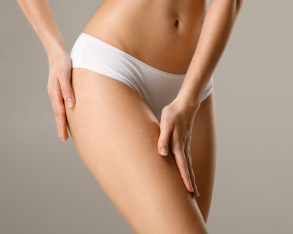
The classic thigh lift requires an incision just below the femoral axil that runs along the inner thigh. The plastic surgeon then proceeds to remove redundant fatty tissue and skin, shaping this part of the body. The skin is then stretched and sewn with fine surgical suture.
The problem of massive legs, especially of their upper part, may affect the young and old alike. It’s typical of people with overweight thighs and buttocks and afflicts women more often than men. The upper part of their body is commonly slim, while the redundant kilos accumulate from their waist down, in buttocks, thighs as well as calves. This type of overweight is less harmful than abdominal, manifests not only outside, but also as adiposity of inner organs. Although it’s easier to get rid of overweight buttocks and thighs than stomach, thighs may resist even regular exercise and a healthy diet. It’s becoming harder to solve the problem of a massive upper part of your legs as you age. Losing collagen, the skin is less flexible, finds it more difficult to constrict and, if weight is lost, frequently becomes drooping and there’s too much of it. Excess fat is stored in thighs and cellulite may appear on the skin, too. Those suffering from such afflictions seem older, heavier, and slower than they are in fact. A flaccid and unattractive skin lowers self-assessment even more than massive thighs do.
If the imperfections do not recede after appropriately selected, regular exercise, it’s a good idea to consider the opportunities offered by state-of-the-art plastic surgery and its variety of thigh shaping and skin lifting techniques.
Thigh lift is a procedure that reduces excessive loose and useless skin that often arises following substantial weight losses. A standard skin lift requires an approximately 20-30 cm incision starting just below the femoral axil and running down along the inner thigh side. Patients with less of flaccid skin in the upper part of their leg can have a less extensive skin excision, namely, mini-lifting. Only minimal scars in the axillary region remain after this procedure. The recovery time is shorter. Thighs are appropriately lifted and acquire a delightful shape.
Thigh liposuction is an alternative to the lifting that is designed to reduce the volume of this body region by removing excess fatty tissue and precise modelling, or forming of a desired shape. Contrary to exercise, which only reduces the size of fatty tissue, the liposuction cuts the numbers of these cells.
During a liposuction, the plastic surgeon makes fine incisions on the Patient’s skin through which excess fatty tissue is first broken and then suctioned using a special device. Careful to evenly distribute the remaining tissue, the surgeon forms the operated area. You can read more about the liposuction in the Liposuction page.
Patients facing the double problem of excess fatty tissue and excess skin can undergo two medical procedures in a single session that make up a full thigh lift.
The end result of a combined lift and liposuction will be more impressive. Thighs will be more shapely and attractive and the skin smooth and flexible.
Preparation for your procedure:
Patients planning or expecting a surgery are requested to read ‘Guide for the Patient – preparation for your procedure’, available in the INFORMATION section.
Recommendations following a thigh lift:
- Stay at the clinic: if the surgery is under a general anaesthesia, the Patient will remain at the clinic for 1 day;
- Dressing and special clothing: the Patient should wear special pressure clothing for 4 weeks that will shape this body region;
- Reduced mobility: limit any more intense activities, including exercises of thigh muscles, for 2 weeks following the surgery; 2 months after your procedure and on consulting your doctor, you can take up sports and exercise again, but only if they don’t cause pains in the operated area;
- Medication: you can only take drugs consulted with a specialist after your procedure; take any strong painkillers with caution and if you do, driving is prohibited; aspirin and any other medication interfering with blood clotting must not be administered:
- Other: lymphatic massages and special scar ointments are recommended after your sutures are removed; you mustn’t go to a sauna for 6 months; sunbathing of the operated areas is prohibited for at least 6 months; a high UV filter cream is recommended;
- Follow-up visits: Patients must attend follow-up visits arranged with their doctor.
Patients will be informed in detail about any recommendations following their procedures at the clinic.