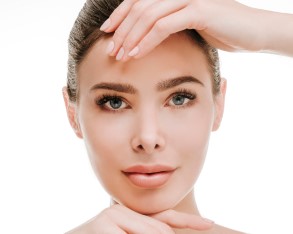
The forehead lifting or browpexy – also described as a face lift in its upper third part – involves raising of the forehead by uniform skin tensioning and removal of excess skin. Forehead muscles are tightened and low-lying brows are raised as well. If needed, all or part of a muscle that causes brow frowning and formation of horizontal skin folds is removed. However, this extended procedure increases the risk of complications.
In the classic operation, the surgical incision begins and ends above the ears, running in the upper part of the head along the hairy skin, so that the resulting scar is well concealed and won’t draw attention. Modified techniques allow cuts along the forehead hair line. The endoscopic technique of short incisions in the hairy head skin and specialist hookwires is often applied now. A plastic surgeon places fine stitches where the incisions are, so that traces of the surgery, once healed, are nearly invisible.
Your expression depends on the shape and position of your brows and mouth. We may not know it, but we do evaluate their shape and position subconsciously, attributing a given mood to somebody. Hanging position of your eyebrows can substantially change the whole expression. For instance, brows positioned low over the eyes suggest fatigue and sadness. Brows wrinkling towards the top part of your nose are evidence of anger and dissatisfaction. Properly positioned and lightly raised brows are associated with serenity, on the other hand. Therefore, correcting the position of drooping eyebrows changes not only the appearance of your face, but also affects the impression you make on others, which translates into more comfortable social life.
Depending on intensity of ageing and the Patient’s requirements, the forehead lifting or browpexy may be combined with other procedures, e.g. plastic surgery of upper or lower eyelids (blepharoplasty), fat transplants (lipofilling), PRP (platelet-rich plasma), or even face and neck lifting.
The lifting provides a natural effect, individual face characteristics are preserved and your forehead becomes more attractive. Following a forehead surgery, the skin in this part of your face is tighter and wrinkles less visible. Brows no longer seem drooping and heavy, your eyes become more noticeable and thus more attractive. Temple wrinkles are more shallow, too. As a result, your face seems more serene and youthful in appearance. It must be remembered, however, a forehead lifting alone won’t guarantee a full rejuvenation of your face, whose middle and lower parts age more quickly than the forehead. Thus, combining a forehead lifting or browpexy with other facial procedures produces a more spectacular, comprehensive effect of rejuvenation.
First effects of a forehead and brow lifting can be observed 2-4 weeks after the procedure. This time is required for possible bruising and swelling to vanish and for the skin to partly regenerate.
Preparation for your procedure:
Patients planning or expecting a surgery are requested to read ‘Guide for the Patient – preparation for your procedure’, available in the INFORMATION section.
Recommendations following a forehead lifting and brow raising:
- Stay at the clinic: following a surgery under general anaesthesia, a Patient will remain in the clinic for 1-2 days;
- Reduced mobility: Limit your forehead movements and lead a sparing life until the bruising and swelling recede;
- Dressing and special clothing: wear a special elastic band on your forehead for 2 weeks;
- Medication: antibiotics are not taken following the surgery as a rule. If needed, the Patient will take medication consulted with their doctor; you mustn’t use aspirin or other substances interfering with blood clotting;
- Other: loose clothing is recommended; you mustn’t smoke or stay in the presence of smokers, or drink alcohol or drinks containing caffeine until the end of the healing process; avoid solarium or sunbathing for 6 months;
- Follow-up visits: Patients must attend follow-up visits arranged with their doctors.
Patients will be informed in detail about any recommendations following their procedures at the clinic.