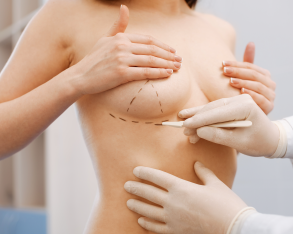
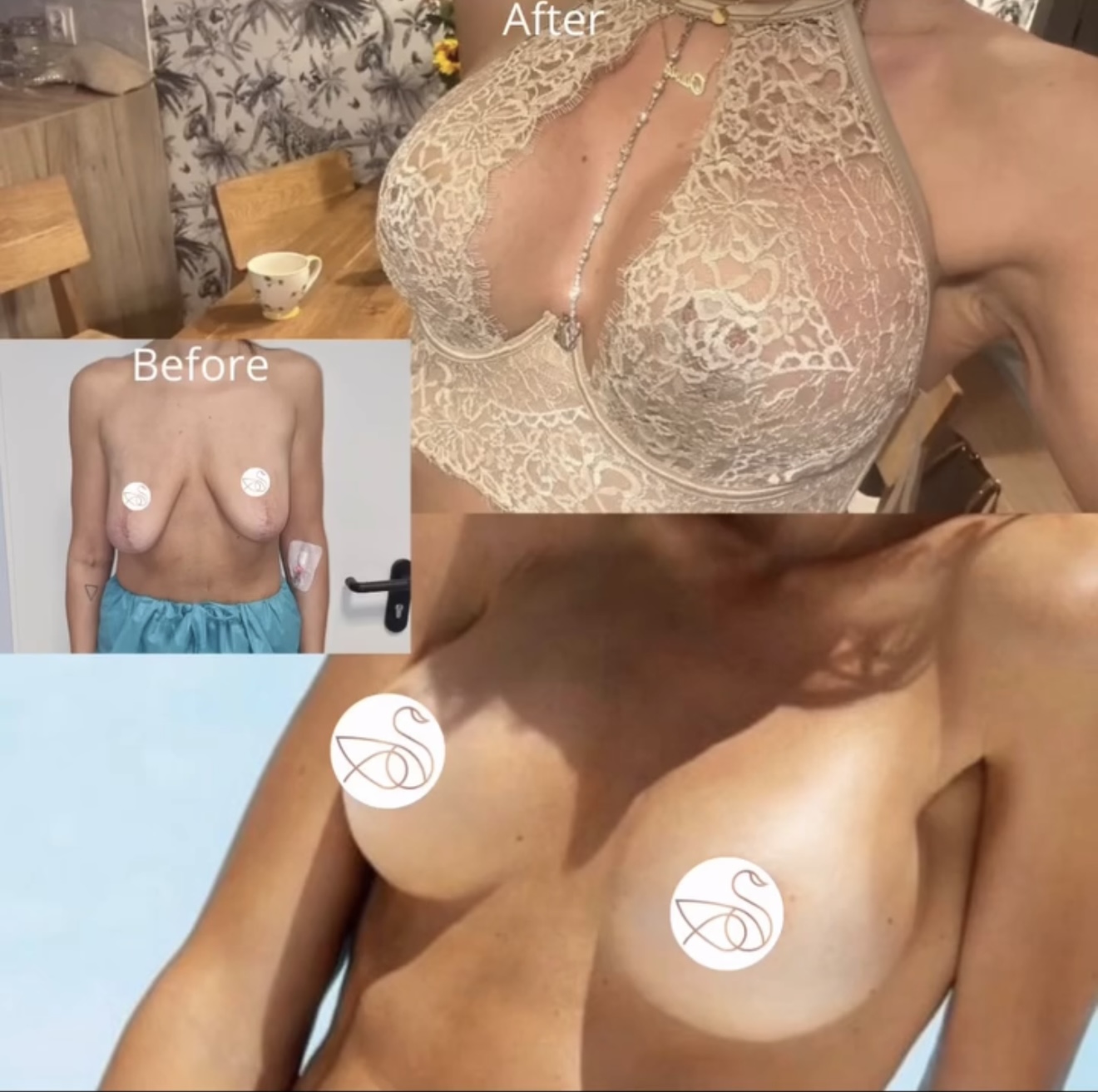
Lack of all or part of a breast is most frequently caused by its condition following oncological treatment of breast cancer, far more seldom by hereditary defects, traumas or burns. Oncological treatment of breast cancer, the most common neoplasm in Polish women, entails the necessity of a mastectomy in some Patients. This sometimes reduces their self-assessment and leaves a stigma of disease. Breast reconstruction will not only help to reach the desired breast volume but also contribute to an improved comfort of living.
Planning of a breast reconstruction requires significant commitment not only of a plastic surgeon but also the Patient herself. A number of variables must be taken into consideration. The Patient’s overall health condition, her oncological status, body build, and appearance of the existing breast are of paramount importance. Breast reconstruction is usually beneficial to Ladies after the process of treatment following removal of an oncological lesion. The quantity of tissue remaining in the chest region and the potential for using tissue from other body parts must be taken into account as well. In the process of preparation, the Patient’s expectations of breast shape and size and surgical techniques matter, too. Therefore, the Patient is often actively involved in the planning process to work out an optimal procedure together with her doctor.
Breast reconstruction may be carried out at the same time as amputation or it may be delayed in time. Simultaneous mastectomy and reconstruction are common in treatment of breast cancer Patients. This brings a range of benefits, beginning with rapid aesthetic effects and thus a faster end of recovery. A delayed reconstruction, following a mastectomy and other stages of oncological treatment as a rule, is an alternative to such simultaneous reconstruction.
If mastectomy is combined with a reconstruction, the specialist excises the mammary gland and neoplastic tissue while leaving sufficient skin area to place an implant or expander in the defective location. Appropriate breast symmetry is not attained in some surgeries of this type. In the circumstances, the opposing breast is symmetrised after a period of recovery. As far as the simultaneous procedure is concerned, the nipple-areola complex can be saved in some clearly specified cases. It is normally reconstructed at a later date, however.
Depending on oncological treatment in place and the Patient’s preferences, a missing breast can be reconstructed with her own tissue or with implants. Contemporary plastic surgery offers a wide gamut of available reconstruction techniques. If the skin flap in the region of a removed breast is sufficient, the reconstruction involves implanting. The skin flap is commonly insufficient, which requires an expander to be grafted to stretch the skin and prepare the area for an implant proper. After some time, the expander is replaced with an endoprosthesis.
Reconstruction with own tissue from other body parts, possibly with the addition of an implant, is an alternative to prosthetic techniques. In the case of breast reconstruction with a latissimus dorsi muscle flap, the back skin and muscle are transferred and supplemented with an implant or expander. Abdominal tissues may also serve the purposes of breast reconstruction, for instance, the TRAM flap (including part of the abdominal rectus) or DIEP flap, the skin and fat of this region. These tissues are normally sufficient to form a new breast. The technique employing the myocutaneous flap of the gluteus maximus is another reconstruction method which doesn’t require prostheses. ‘Breast sharing’ is the most interesting technique that can be administered to some Patients. It consists in breast reconstruction with tissue harvested from the contralateral existing breast. The breast is appropriately formed then to make it beautiful, equal, and symmetrical. Absence of scars other than in the chest region is an undoubted advantage of this technique. The method also involves breast symmetrisation to arrive at the best possible aesthetic effect of the surgery.
Breast reconstruction is completed with a reconstruction of the nipple and its areola using the skin of the breast that has already been reconstructed. A special tattoo may possibly be executed in the areola region to produce the characteristic natural colouring.
Breast reconstruction may also utilise only the Patient’s own fatty tissue in some cases. The procedure involves fat removal from one location and its placement in a defective breast. This is less invasive than the traditional breast reconstruction. However, a full breast reconstruction commonly requires several surgeries at considerable time intervals. You can find out more about the fatty tissue transplant in the Lipofilling tab.
Breast reconstruction is of huge importance to the Patient and is often a symbolic closure to the difficult stage of treatment and recovery. Some after a mastectomy or with another defect regain not only a breast or its part, but also self-confidence after such a procedure, becoming more attractive and finding it easier to start their social life again.
Preparation for your procedure:
Patients planning or expecting a surgery are requested to read ‘Guide for the Patient – preparation for your procedure’, available in the INFORMATION section.
Recommendations following a breast reconstruction:
- Stay at the clinic: the Patient remains at the clinic for 1-2 days;
- Dressing and special clothing: wear a protective, specially fitted bra for 8 weeks after your surgery;
- Reduced mobility: the Patient should lie with her head and arms raised and only on her back for the first 3 days, you can also sleep on your back but never lie on your stomach for the next 2 months; you mustn’t lift your arms high (above the breast level), twist your waist or lift heavy things for the first 2 weeks after your procedure; you can take up sports and exercise again after 2 months, though only with your doctor’s consent and if they don’t cause pain in the operated region,
- Medication: the Patient can only take drugs agreed with her doctor; you mustn’t take aspirin or other drugs interfering with blood clotting;
- Other: breast massaging can begin a week after your procedure at the earliest; you mustn’t go to a solarium and sauna or sunbathe for at least 6 months; a high UV filter cream is recommended when sunbathing;
- Follow-up visits: Patients must attend follow-up visits arranged with their doctor.
Patients will be informed in detail about any recommendations following their procedures at the clinic.